Close Menu
    Facebook X (Twitter) Instagram
    Facebook X (Twitter) LinkedIn
    The Business TimeThe Business Time
    Subscribe
    • London
    • Business
    • Finance
    • Marketing
    • Technology
      • Auto
    • Education
    • Entertainment
    • Lifestyle
      • Travel
      • Food
    The Business TimeThe Business Time
    Home»NEWS»HMRC Warning: How to Spot Fake Tax Refund Texts and Avoid Scams
    NEWS

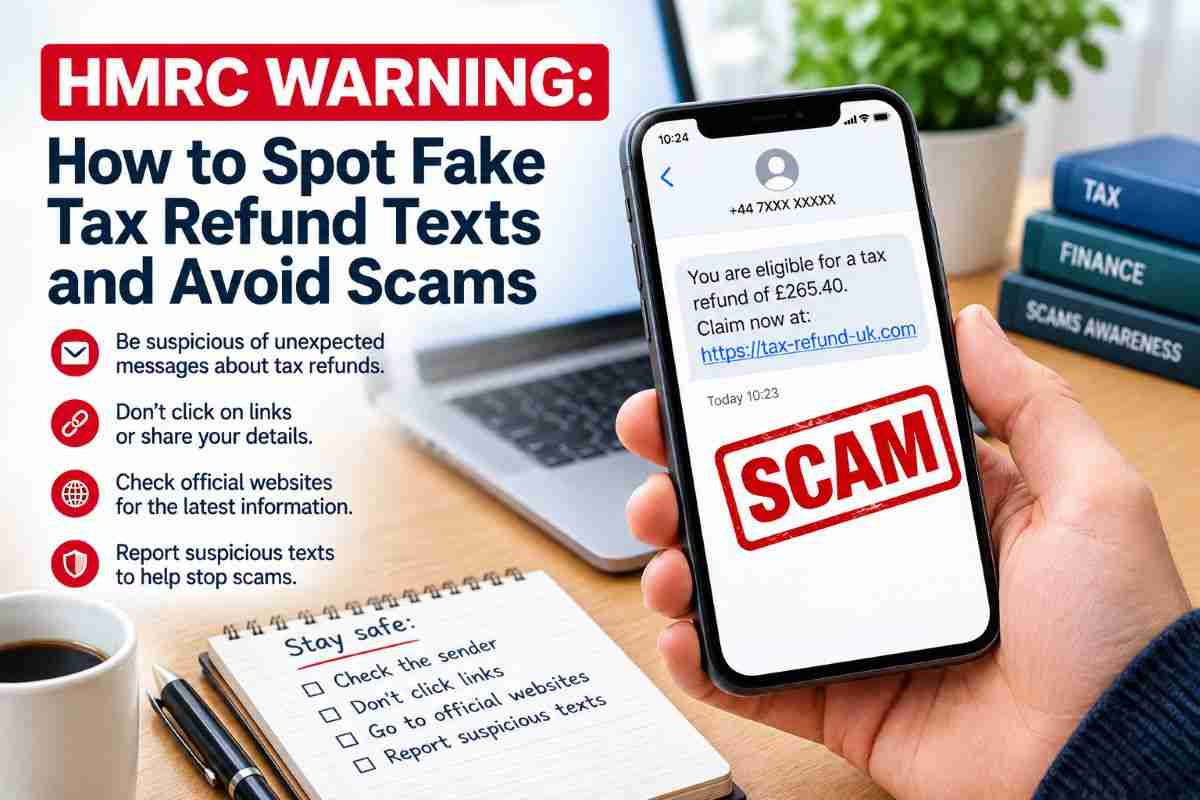
    HMRC Warning: How to Spot Fake Tax Refund Texts and Avoid Scams

    EditorBy EditorSeptember 19, 2026No Comments4 Mins Read NEWS
    Fake Tax Refund Texts
    Share
    Facebook Twitter LinkedIn Pinterest Email

    A text message claiming you are owed a tax refund can be tempting to act on, particularly if it arrives when you are expecting money back from HMRC. But scammers regularly use the promise of a refund to trick people into handing over personal details, banking information or access to their accounts.

    The key question is not simply whether the message looks genuine, but how you can check whether you are actually due a refund without putting your money or personal information at risk.

    Table of Contents

    • What’s actually true about HMRC tax refund texts?
      • Warning signs to look out for
    • How to check whether you are genuinely owed a refund
    • Common mistakes that can put your money at risk
    • What to do if you receive a suspicious text
    • Key takeaways

    What’s actually true about HMRC tax refund texts?

    HMRC does send some legitimate text messages, so receiving one does not automatically mean your phone has been targeted by a scam. The crucial distinction is that HMRC will not send a text notifying you that you are due a tax rebate or asking you to disclose personal or payment information to claim one.

    There are, however, some genuine exceptions worth understanding. HMRC may send a message confirming that a Self Assessment refund you requested is being processed, or explaining when you can expect it. These messages do not include links or request your financial details.

    Warning signs to look out for

    A suspicious message may:

    • Promise an unexpected tax refund or rebate.
    • Ask you to click a link and enter your bank details, National Insurance number or other personal information.
    • Pressure you to act immediately or suggest you will lose the refund if you delay.
    • Use official-looking HMRC branding to appear convincing.

    An HMRC logo or familiar sender name is not proof that a message is genuine. Scammers can imitate official communications, so the content and the request matter more than how convincing the text looks.

    How to check whether you are genuinely owed a refund

    The safest approach is to check your tax position independently, rather than following instructions in an unexpected message.

    A tax refund can be legitimate. For example, PAYE taxpayers may have paid too much tax, while Self Assessment customers may be entitled to a repayment after their tax position has been calculated.

    HMRC may issue a P800 tax calculation explaining that someone has overpaid tax. Its official guidance says it may send a text about a P800 refund if it has already sent a letter and received no response. That text will not contain a link or ask for personal or financial information.

    If you think you may be owed money:

    1. Type GOV.UK into your browser yourself, rather than using a link in the message.
    2. Sign in to your HMRC online account or use the official HMRC app.
    3. Check your tax calculation, repayment status and any relevant correspondence.
    4. Follow the repayment instructions provided through the official service.

    If you are unsure, use HMRC contact details obtained independently from GOV.UK.

    Common mistakes that can put your money at risk

    Assuming every HMRC text is fake: Genuine messages do exist, particularly confirmations relating to services you have used. Check the official list of genuine HMRC messages before deciding.

    Believing a refund must be real because you recently filed a tax return: Scammers can exploit tax deadlines and the expectation of a repayment. Timing alone proves nothing.

    Trusting a link because it looks official: A convincing-looking website may be designed to steal your login details or banking information. Avoid links in unexpected refund offers.

    Ignoring a message without checking your tax account: Deleting a suspicious text is sensible, but if you genuinely expect a repayment, check your account separately so you do not overlook legitimate tax correspondence.

    What to do if you receive a suspicious text

    Forward the message to 60599. Network charges may apply. You can also report suspicious HMRC-related messages by emailing phishing@hmrc.gov.uk, then delete the text.

    If you have already entered your bank details or HMRC sign-in information, contact your bank promptly if financial information was exposed, change compromised passwords and follow HMRC’s official security guidance. If you have lost money, report the fraud through the appropriate UK fraud-reporting service.

    Key takeaways

    A genuine tax refund is possible, but an unexpected text promising money is not proof that HMRC owes you anything. Check your tax account independently, never provide financial details through a refund text, and report suspicious messages rather than engaging with them.

    Verification note: HMRC’s genuine-text guidance was updated on 18 September 2026. Its current list should be checked before publication, particularly for any changes to legitimate message types or reporting procedures. The figures in HMRC’s August 2025 Self Assessment scam warning are historical and have not been presented here as current statistics.

    Share. Facebook Twitter Pinterest LinkedIn Tumblr Email
    Previous ArticleHow Self-Service Kiosks Are Changing the Way Customers Interact with Businesses
    Editor

    Related Posts

    Almost 7 Million UK Adults Have Never Checked Their State Pension — Why That Matters

    September 15, 2026

    Practical Magic 2 lands in UK cinemas — here’s how it’s doing

    September 12, 2026

    John Bishop Cancels Comedy Shows After Breaking Ankle — What Fans Need to Know

    September 5, 2026
    Latest Post

    HMRC Warning: How to Spot Fake Tax Refund Texts and Avoid Scams

    September 19, 2026

    How Self-Service Kiosks Are Changing the Way Customers Interact with Businesses

    September 17, 2026

    Almost 7 Million UK Adults Have Never Checked Their State Pension — Why That Matters

    September 15, 2026

    Practical Magic 2 lands in UK cinemas — here’s how it’s doing

    September 12, 2026

    Understanding The Key Terms of a Franchise Agreement

    September 9, 2026

    John Bishop Cancels Comedy Shows After Breaking Ankle — What Fans Need to Know

    September 5, 2026

    How a Franchise Consultant Can Facilitate Your Business Growth Plans

    September 2, 2026

    Beefeater Rewards Club customers have just days to use their points before they expire

    August 29, 2026

    Boy George Faces Backlash After Surprise Pro-Israel Song Sparks Fierce Online Debate

    July 28, 2026

    What £100 Is Really Worth in Nigeria Right Now — And Why It Matters for UK Families

    July 25, 2026
    About
    About

    Welcome to The Business Time – UK’s Leading Business Magazine. We are a UK-based business magazine that covers all trending and relevant business stories around UK.

    Facebook X (Twitter) LinkedIn
    Latest Post

    HMRC Warning: How to Spot Fake Tax Refund Texts and Avoid Scams

    September 19, 2026

    How Self-Service Kiosks Are Changing the Way Customers Interact with Businesses

    September 17, 2026

    Almost 7 Million UK Adults Have Never Checked Their State Pension — Why That Matters

    September 15, 2026
    Quick Links
    • London
    • Business
    • Finance
    • Marketing
    • Technology
      • Auto
    • Education
    • Entertainment
    • Lifestyle
      • Travel
      • Food
    © 2026 The Business Time.
    • About Us
    • Privacy Policy
    • Write for us
    • Contact us

    Type above and press Enter to search. Press Esc to cancel.

    We use cookies on our website to give you the most relevant experience by remembering your preferences and repeat visits. By clicking “Accept”, you consent to the use of ALL the cookies.
    Cookie settingsACCEPT
    Manage consent

    Privacy Overview

    This website uses cookies to improve your experience while you navigate through the website. Out of these, the cookies that are categorized as necessary are stored on your browser as they are essential for the working of basic functionalities of the website. We also use third-party cookies that help us analyze and understand how you use this website. These cookies will be stored in your browser only with your consent. You also have the option to opt-out of these cookies. But opting out of some of these cookies may affect your browsing experience.
    Necessary
    Always Enabled
    Necessary cookies are absolutely essential for the website to function properly. These cookies ensure basic functionalities and security features of the website, anonymously.
    CookieDurationDescription
    cookielawinfo-checbox-analytics11 monthsThis cookie is set by GDPR Cookie Consent plugin. The cookie is used to store the user consent for the cookies in the category "Analytics".
    cookielawinfo-checbox-functional11 monthsThe cookie is set by GDPR cookie consent to record the user consent for the cookies in the category "Functional".
    cookielawinfo-checbox-others11 monthsThis cookie is set by GDPR Cookie Consent plugin. The cookie is used to store the user consent for the cookies in the category "Other.
    cookielawinfo-checkbox-necessary11 monthsThis cookie is set by GDPR Cookie Consent plugin. The cookies is used to store the user consent for the cookies in the category "Necessary".
    cookielawinfo-checkbox-performance11 monthsThis cookie is set by GDPR Cookie Consent plugin. The cookie is used to store the user consent for the cookies in the category "Performance".
    viewed_cookie_policy11 monthsThe cookie is set by the GDPR Cookie Consent plugin and is used to store whether or not user has consented to the use of cookies. It does not store any personal data.
    Functional
    Functional cookies help to perform certain functionalities like sharing the content of the website on social media platforms, collect feedbacks, and other third-party features.
    Performance
    Performance cookies are used to understand and analyze the key performance indexes of the website which helps in delivering a better user experience for the visitors.
    Analytics
    Analytical cookies are used to understand how visitors interact with the website. These cookies help provide information on metrics the number of visitors, bounce rate, traffic source, etc.
    Advertisement
    Advertisement cookies are used to provide visitors with relevant ads and marketing campaigns. These cookies track visitors across websites and collect information to provide customized ads.
    Others
    Other uncategorized cookies are those that are being analyzed and have not been classified into a category as yet.
    SAVE & ACCEPT